AI Fashion Photography Studio in India: The Complete Guide for Clothing Brands
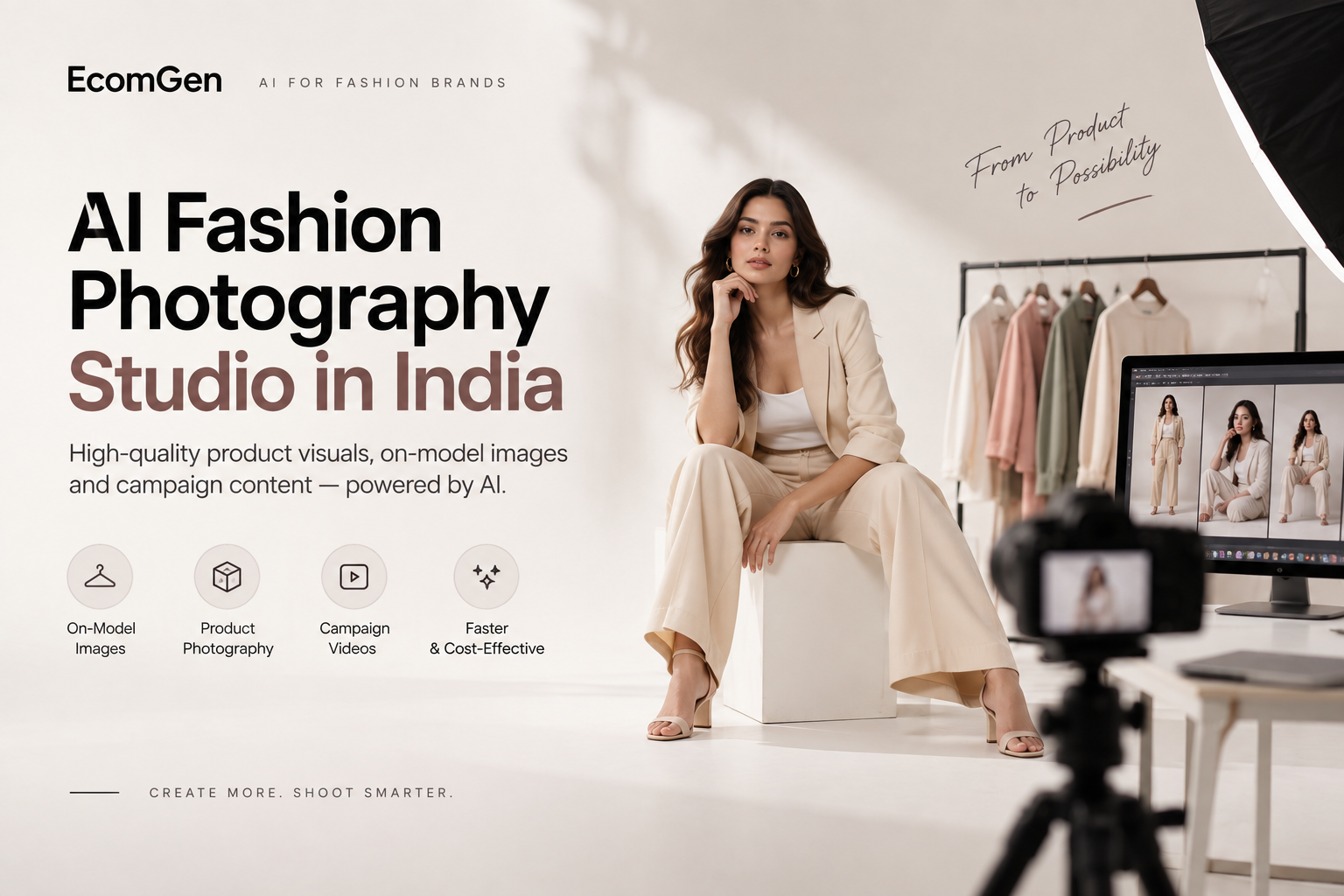
An AI fashion photography studio helps clothing brands create product visuals, on-model images, and campaign content using artificial intelligence. This guide explains how the technology works, its benefits, limitations, and how Indian fashion brands can use it in their production workflow.
Fashion e-commerce in India is becoming increasingly visual. Customers often explore a product through its images before deciding whether to read its description, check the size chart, or make a purchase.
For fashion brands, this creates a practical challenge: how do you produce high-quality photography for dozens or hundreds of products without repeatedly coordinating models, photographers, studios, stylists, and editing teams?
An AI fashion photography studio in India offers an alternative production workflow. Brands can use AI to generate selected product images, model visuals, lifestyle scenes, and marketing assets from product references.
Platforms such as EcomGen are designed around a broader fashion production workflow, combining AI image generation, video creation, and campaign-oriented content production.
What Is an AI Fashion Photography Studio?
An AI fashion photography studio is a digital production environment that uses artificial intelligence to create or transform fashion images.
Depending on the platform and workflow, a brand may be able to upload a garment image and generate:
- On-model fashion photographs
- E-commerce product images
- Lifestyle and editorial scenes
- Studio-style product compositions
- Different model poses and camera angles
- Social media campaign creatives
- Product-focused advertising visuals
Traditional fashion photography generally requires physical equipment, a location, models, styling, and a photography team. AI photography can reduce the need for some of these resources for specific image-production tasks.
However, AI-generated visuals are not automatically accurate. Garment shape, fabric texture, embroidery, prints, accessories, and draping must be reviewed carefully, especially when the image represents a product that customers will purchase.
Why Are Indian Fashion Brands Exploring AI Photography?
Indian fashion businesses operate across a wide range of categories, including western wear, ethnic wear, occasionwear, activewear, kidswear, accessories, and value-fashion products.
Many brands also sell through multiple channels, including:
- Their own e-commerce websites
- Myntra
- Amazon India
- Flipkart
- Meesho
- Ajio
- Instagram and other social media platforms
Each channel may require different image dimensions, compositions, and content formats. Brands also need fresh creative material for launches, seasonal campaigns, discounts, advertisements, and social media.
Traditional photography remains valuable, but it can become difficult to scale when a business needs to produce visuals for a large catalogue within a short period.
AI fashion photography can support brands by helping them test different visual directions and create additional content without arranging a separate physical shoot for every variation.
How Does AI Fashion Photography Work?
The exact process depends on the platform, AI model, and input quality. A typical AI fashion photography workflow includes the following steps.
Step 1: Upload the Product Reference
The brand uploads a product image, such as:
- A flat-lay photograph
- A mannequin image
- A studio product photograph
- A garment image on a plain background
The quality of the input affects the quality of the output. Images with clear lighting, visible garment details, and minimal obstruction generally provide a stronger starting point.
Step 2: Select the Desired Visual Style
The user chooses the type of image they want to produce.
- E-commerce catalogue
- Minimal studio
- Premium editorial
- Outdoor lifestyle
- Festive campaign
- Streetwear
- Resortwear
- Contemporary ethnic fashion
Some platforms also provide options for model appearance, pose, background, framing, and lighting.
Step 3: Generate the Image
The AI system processes the product reference and selected instructions to create a new visual.
The result may place the garment on an AI-generated model or in a digitally created environment. The system attempts to maintain important product characteristics while changing the surrounding composition.
Results vary by model and garment type. A generated image should not be treated as a guaranteed reproduction of the original garment.
Step 4: Review and Refine
A professional production workflow should include quality control.
The brand should review:
- Garment silhouette
- Print and pattern accuracy
- Colour consistency
- Stitching and embroidery
- Neckline and sleeve construction
- Buttons, zippers, and accessories
- Hands and body proportions
- Fabric draping
- Background and lighting
- Unwanted visual artifacts
If the output changes an important product detail, the image should be regenerated, edited, or replaced with a verified photograph.
Step 5: Export and Prepare for Publishing
Final images can be adapted for their intended use, including product listings, websites, paid advertisements, social media, and campaign presentations.
Brands should still check the image requirements and commercial policies of each marketplace before publishing generated content.
AI Fashion Photography vs Traditional Fashion Photography
AI photography and traditional photography serve different production requirements. The right approach depends on the purpose of the image, the product category, the budget, and the level of accuracy required.
| Factor | Traditional Photography | AI Fashion Photography |
|---|---|---|
| Models | Physical models or mannequins | AI-generated or digitally created models |
| Location | Studio or real-world location | Generated or digitally selected environment |
| Production planning | Requires physical coordination | Can reduce coordination for selected workflows |
| Product accuracy | Direct physical reference | Requires careful verification |
| Creative variations | Usually requires additional shooting or editing | Can generate alternative concepts |
| Physical product inspection | Possible during the shoot | Must be checked against source references |
| Best suited for | Campaigns requiring real people, physical detail, and direct capture | Concept development, selected catalogue assets, and scalable creative production |
AI photography should not be viewed as a universal replacement for professional photography. It is another production method that can complement existing teams and workflows.
Benefits of Using an AI Fashion Photography Studio in India
1. Faster Creative Exploration
A brand can explore different backgrounds, styling directions, poses, and campaign concepts without physically arranging a new shoot for every variation.
This is useful during product launches and campaign planning, when teams need to compare several creative options.
2. Additional Content for Large Catalogues
Fashion businesses often manage multiple SKUs and seasonal collections. AI workflows may help generate additional image variations from existing product references.
The amount of time saved depends on the platform, image complexity, review process, and number of revisions required.
3. More Flexible Creative Testing
A single product can be presented in different visual environments, such as:
- Studio catalogue
- Everyday lifestyle
- Premium editorial
- Seasonal campaign
- Social media advertising
This can help marketing teams explore creative directions before investing in a larger production.
4. Support for Growing D2C Brands
Smaller fashion brands may not have an in-house photography team or a large recurring production budget.
An AI-based workflow can give them another way to develop visual concepts and produce selected marketing assets. The final suitability depends on image quality, product complexity, and the brand’s standards.
5. Integration With Broader Content Production
Modern fashion marketing requires more than product photographs. Brands also need:
- Product videos
- Promotional creatives
- Social media content
- Campaign banners
- Marketplace visuals
- Website imagery
A fashion production platform that combines image and video workflows can reduce the need to manage every task through separate tools.
Can AI Fashion Photography Handle Indian Ethnic Wear?
Yes, AI can be used to create ethnic-fashion visuals, but complex garments require additional attention.
Indian fashion includes products such as:
- Sarees
- Lehengas
- Anarkalis
- Kurtas
- Salwar suits
- Sherwanis
- Embroidered jackets
- Dupattas
These garments can contain detailed embroidery, intricate borders, layered construction, pleats, and specific draping styles.
Common Challenges
AI-generated fashion images may introduce errors in:
- Saree pleats and pallu placement
- Embroidery patterns
- Border width
- Garment length
- Sleeve construction
- Fabric folds
- Jewellery and accessories
- Dupatta positioning
For this reason, brands should use AI-generated images carefully for product representation. A visually attractive image is not sufficient if it misrepresents the actual garment.
For high-detail products, compare the generated output with the original reference and retain verified photography wherever accurate product documentation is essential.
AI Photography for Myntra, Amazon India, and Other Marketplaces
AI-generated images may be useful for e-commerce, but marketplace acceptance should never be assumed.
Each marketplace can have its own requirements relating to:
- Image dimensions
- Backgrounds
- Product visibility
- Model presentation
- Watermarks
- Text and promotional overlays
- Category-specific content
- Authenticity and customer representation
Before uploading AI-generated imagery, brands should check the current seller guidelines of the relevant marketplace.
An image created for an Instagram advertisement may not be suitable as the primary image of a marketplace listing.
A practical workflow is to maintain separate image sets for:
- Primary product listing images
- Additional catalogue images
- Website and brand imagery
- Paid advertising
- Social media content
This approach allows the brand to choose the appropriate visual for each channel instead of using one image everywhere.
Start Using EcomGen
How to Choose an AI Fashion Photography Studio in India
Not all AI image-generation tools are designed for the same use case. A brand should evaluate a platform according to its actual production requirements.
1. Garment Accuracy
Can the platform preserve the key details of your products?
Test it with different materials, prints, embroidery, silhouettes, and colours rather than judging it from a single sample.
2. Model and Styling Options
Consider whether the platform offers the visual styles your brand needs.
For Indian fashion brands, this may include different model appearances, styling preferences, body proportions, and cultural contexts.
3. Output Quality
Review the output at the size in which it will actually be used.
Check for:
- Pixelation
- Distorted garment details
- Artificial skin textures
- Incorrect shadows
- Deformed accessories
- Inconsistent proportions
4. Brand Consistency
A useful production platform should support a consistent visual identity.
Your brand may need repeatable choices for:
- Backgrounds
- Lighting
- Model styling
- Colour palette
- Composition
- Product presentation
Consistency is particularly important when multiple images appear together on a website or campaign.
5. Editing and Revision Workflow
AI generation often requires refinement. Look for a workflow that makes it practical to review, regenerate, and organize outputs.
6. Commercial Usage and Privacy
Before using a platform, review its terms relating to commercial usage, data handling, uploaded images, and generated content.
Do not upload confidential product designs, unreleased collections, or customer photographs without understanding the applicable permissions and policies.
How EcomGen Fits Into AI Fashion Production
EcomGen is an AI fashion production platform designed to bring multiple creative workflows into one environment.
Depending on the selected workflow, fashion businesses can use the platform for tasks such as:
- AI product photography
- AI fashion imagery
- Product video generation
- Campaign content
- Advertising creatives
- E-commerce-focused visual production
The value of a production platform is not simply generating one image. It is helping a brand move from a product reference to usable creative assets through a repeatable workflow.
For best results, brands should define their product requirements, establish visual guidelines, review outputs, and maintain a quality-control process before publishing generated content.
Is AI Fashion Photography Worth Using for Your Brand?
AI fashion photography can be useful when a brand needs to explore creative concepts, create additional visual variations, or support content production at scale.
It may be particularly relevant for:
- D2C fashion businesses
- Clothing manufacturers
- Emerging fashion labels
- Marketplace sellers
- Marketing agencies
- E-commerce content teams
- Brands launching frequent collections
However, the decision should be based on actual output quality and production needs.
A brand should test a representative sample of its products before moving to a large-scale workflow. Include simple garments as well as challenging products such as embroidered clothing, sarees, and layered outfits.
The most effective approach may be a hybrid one: use traditional photography when direct physical accuracy is essential, and use AI for suitable creative, marketing, and production tasks.
Frequently Asked Questions
What is an AI fashion photography studio?
An AI fashion photography studio is a digital tool or platform that uses artificial intelligence to create fashion images, model visuals, product photographs, and campaign content from product references and user instructions.
Can AI create fashion model photos from a garment image?
Yes. Some AI platforms can generate on-model fashion visuals from garment references. Accuracy depends on the input image, AI model, garment complexity, and the platform’s workflow.
Is AI fashion photography suitable for Indian clothing brands?
It can be suitable for selected use cases, including creative development, marketing visuals, and some catalogue workflows. Brands should verify garment details, especially for sarees, lehengas, embroidery, and other complex clothing.
Can AI-generated images be used on Myntra or Amazon India?
Potentially, but acceptance depends on the applicable marketplace policies and the image’s compliance with their requirements. Always check current seller guidelines before publishing.
Is AI fashion photography cheaper than a traditional photoshoot?
AI may reduce certain production expenses, but the total cost depends on the platform’s pricing, generation credits, revisions, quality control, and the type of images required. Compare the complete workflow rather than only the cost of generating one image.
Does AI photography replace professional fashion photographers?
Not in every situation. Traditional photography remains important when brands require direct product capture, physical styling, real locations, or precise documentation. AI can complement professional photography for selected creative and production tasks.
What should I upload for better AI fashion photos?
Use a clear, well-lit product reference that shows the garment’s important details. Include sufficient visibility of the shape, colour, print, construction, and material. Review generated results against the original product.
Final Thoughts
AI fashion photography is becoming part of the broader toolkit available to fashion and e-commerce businesses in India.
Its practical value depends on more than generation speed. Brands need accurate product representation, consistent creative direction, reliable review processes, and a workflow that fits their publishing requirements.
Whether you are building a new D2C clothing brand or managing a large fashion catalogue, AI photography is worth evaluating through real product tests rather than assumptions.
The goal is not simply to generate more images. It is to create useful, consistent, and commercially appropriate fashion content with a production process your team can manage.
Usefull Links:
Gemini 3.8 Live