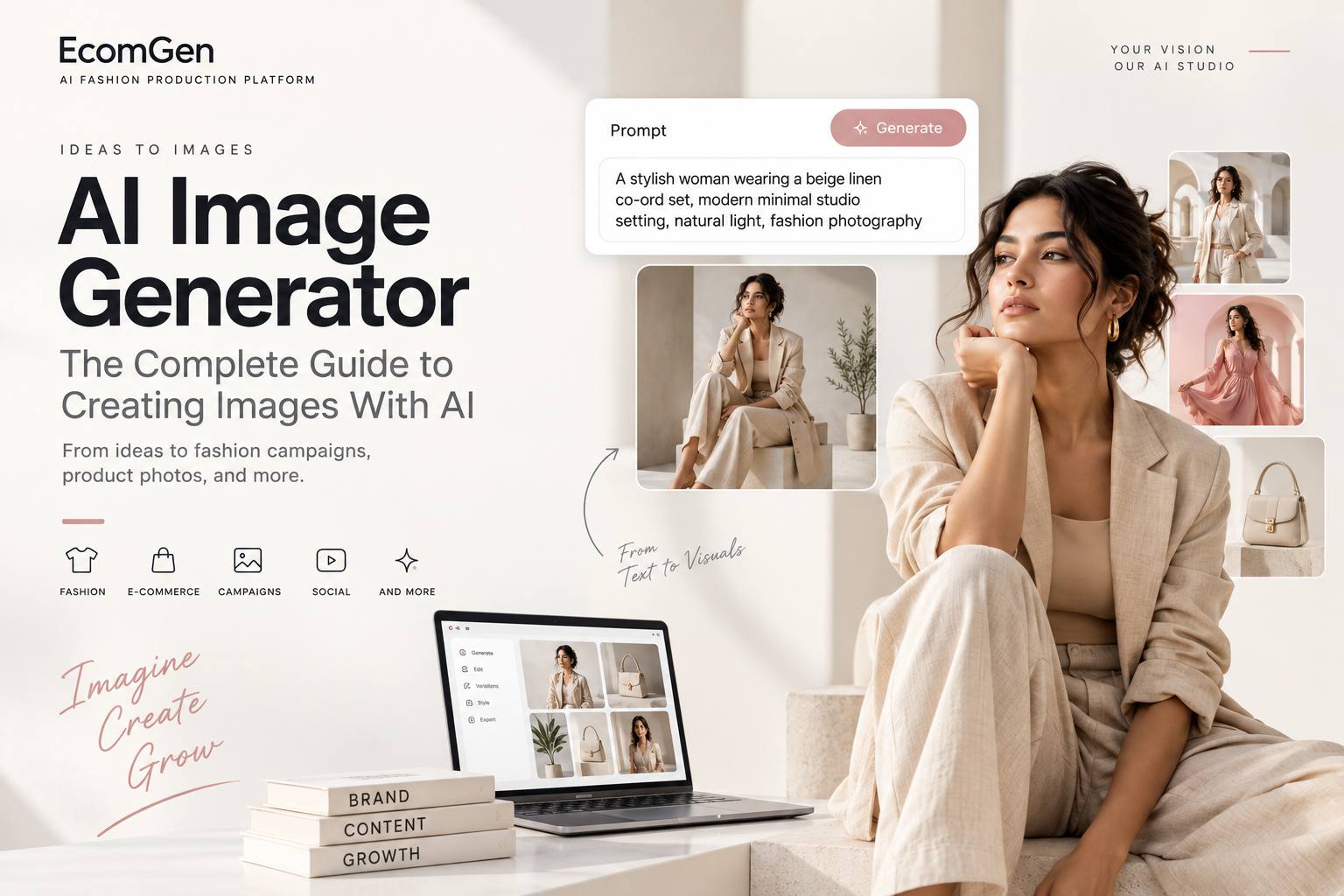
What is an image generator AI? An image generator AI is a sophisticated machine learning system powered by diffusion models that creates photorealistic images from text prompts or reference inputs. For the e-commerce sector, an enterprise-grade AI image generator goes beyond creating digital art—it utilizes advanced neural networks to map garments onto virtual models, swap backgrounds, and generate marketplace-ready lifestyle assets while maintaining absolute product accuracy.
For fashion, jewelry, and D2C brands, the visual content pipeline has always been the most expensive bottleneck. Traditional studio photography requires massive budgets, complex logistics, and weeks of post-production. Today, an image generator AI completely disrupts this model. It empowers brands to generate high-converting AI fashion photography, global campaign assets, and localized marketplace imagery at a fraction of the cost and time.
In this comprehensive guide, we will dive deep into the architecture of modern AI image generation, compare traditional photoshoot economics with AI workflows, and explore how platforms like EcomGen are building the future of AI fashion production.
What is an Image Generator AI and How Does it Work?
At its core, a modern image generator AI relies on Latent Diffusion Models (LDMs) like Stable Diffusion or FLUX. These models are trained on billions of image-text pairs. When given a text prompt, the AI starts with a field of random digital noise and iteratively “denoises” it, arranging pixels until a coherent image emerges that matches the semantic meaning of the prompt.
However, generic AI generators fail at e-commerce. If you ask a standard AI tool to generate an image of a model wearing a specific floral dress, the AI will “hallucinate” a brand new dress that looks similar, but is fundamentally a fake product. You cannot sell a hallucinated product to a customer.
To solve this, specialized e-commerce AI production platforms use advanced conditioning technologies to constrain the AI, forcing it to respect the exact physical properties of your SKU.
The Essential AI Technologies for Fashion Production
- ControlNet (Structure Locking): This is the backbone of AI product photography. ControlNet extracts the exact edges, depth, and pose of your garment from a basic flat-lay or ghost mannequin photo. It forces the image generator AI to preserve the exact silhouette, cut, and fall of the garment while generating a photorealistic model and background around it.
- VTON (Virtual Try-On): Advanced VTON pipelines allow brands to map 2D garments onto diverse AI models in 3D space, ensuring natural fabric draping, realistic lighting, and accurate shadows.
- LoRA (Low-Rank Adaptation): LoRAs are custom-trained micro-models. D2C brands use LoRAs to train the AI on their specific brand identity, a recurring brand ambassador’s face, or a specific aesthetic (e.g., “moody editorial lighting with a 35mm lens effect”).
- IP-Adapter (Image Prompting): Instead of relying purely on text, IP-Adapters allow the AI to use an image as a prompt. This is crucial for maintaining the exact color, texture, and visual fidelity of intricate materials like silk, denim, or leather.
- Inpainting & Outpainting: These techniques allow brands to select a specific part of an image (like a background) and regenerate only that section, or expand the borders of an image to fit the aspect ratios of different ad networks and marketplaces.
Traditional Photoshoots vs. AI Image Generators: The ROI Breakdown
For D2C brands and marketplace sellers, visual production is a massive recurring cost. A professional fashion catalog shoot in India typically involves renting a studio, booking models, hiring photographers, and paying for post-production. According to recent e-commerce industry benchmarks, a full catalog shoot day can cost anywhere from ₹75,000 to over ₹2,50,000. When broken down per SKU, traditional on-model photography often ranges from ₹350 to ₹1,500 per item, taking 5 to 14 days from shoot to final delivery.
By contrast, an enterprise image generator AI reduces both the financial and temporal friction to near zero. Brands can generate variations in seconds, scaling their output infinitely without logistical bottlenecks.
| Metric | Traditional Studio Photoshoot | AI Fashion Production |
|---|---|---|
| Time to Market | 1 to 2 weeks (Booking, shooting, editing) | Minutes to hours |
| Estimated Cost (India) | ₹75,000 – ₹2,50,000+ per shoot day | Fraction of the cost (Subscription or low per-image fee) |
| Logistics | Studio rentals, model casting, physical inventory shipping | Zero physical logistics; requires only a smartphone flat-lay photo |
| Creative Flexibility | Locked to the location and hired model | Infinite model diversity, global locations, instant seasonal updates |
| Marketplace Scalability | Requires manual cropping/editing for different platforms | Automated generation of compliant assets for all marketplaces |
Core Use Cases for Global and Indian D2C Brands
1. AI Fashion Photography & Virtual Try-On
Consumers buy what they can visualize. Flat-lay images simply do not convert as highly as on-model lifestyle images. Using an image generator AI, you can take a basic product photo and place it on a photorealistic virtual model. You can instantly swap the model’s ethnicity, age, and body type to cater to diverse global audiences. For example, a Shopify brand can launch a summer collection featuring models in Santorini, Malibu, and Goa, all generated from a single office desk.
2. Generating Marketplace Assets (Amazon India, Myntra, Meesho)
Every e-commerce platform has strict, distinct visual guidelines. Amazon India and Flipkart mandate pure white backgrounds for primary listing images. Myntra favors high-end editorial styling, while Meesho relies heavily on relatable, contextual lifestyle imagery that appeals to Tier-2 and Tier-3 consumers. An AI studio workflow allows you to upload one source image and instantly output platform-compliant variations for all these marketplaces simultaneously.
3. Mastering Indian Ethnic Wear & Jewelry
Indian fashion presents unique challenges for generic AI. Intricate Zari work on a Banarasi Saree, heavy Kundan jewelry sets, and the complex draping of a Lehenga cannot be generalized or blurred. Specialized AI fashion production platforms utilize localized training data and high-fidelity rendering to maintain the sanctity of ethnic wear. The AI ensures the fabric texture, embroidery details, and cultural context are accurately represented, providing boutiques and manufacturers with a massive competitive edge.
4. Campaign Creation: From Image to Video
Static images are just the beginning. AI video generation is the next frontier for digital marketing. Leading platforms now feature image-to-video capabilities, taking your AI-generated lifestyle images and animating them into dynamic, short-form video assets. These fluid, eye-catching videos are perfect for Instagram Reels, Facebook Ads, and TikTok, significantly lowering the barrier to high-end video campaign creation.
How to Implement an AI Fashion Production Workflow
Transitioning from traditional shoots to an AI studio is a straightforward process when structured correctly.
- Capture the Source Image: You don’t need a DSLR. Shoot your garment on a ghost mannequin or lay it flat on a clean, neutral surface. Ensure the lighting is even and the garment is ironed.
- Upload and Configure: Upload the source image into your AI platform. Select the target demographic (model’s age, ethnicity, body type).
- Prompting & Art Direction: Define the environment. EcomGen allows you to specify lighting setups, camera angles, and background environments (e.g., “Golden hour lighting, shot on 50mm lens, modern urban street background”).
- Generation & Iteration: The AI processes the image, locking the product details via ControlNet, and generates multiple high-resolution options in seconds.
- Human Review & Deployment: Always implement a quality control check to ensure brand consistency and perfect product accuracy before pushing the assets to your Shopify store or social media.
Limitations of AI Image Generators (and How to Overcome Them)
While the technology is revolutionary, maintaining brand trust requires understanding its limitations:
- Text and Intricate Logos: AI models still struggle with rendering small, legible text or complex graphic logos perfectly. It is best to use AI for the base lifestyle shot and overlay graphics in post-production.
- Color Accuracy (Delta E): Ensuring the exact hex code or dye color of a garment translates perfectly can be tricky due to AI lighting variables. Advanced platforms use color-matching algorithms to correct the final output.
- The “Uncanny Valley”: Poorly prompted AI can result in unnatural hand rendering or overly smoothed skin textures. Utilizing enterprise-grade models and proper negative prompting ensures natural, human-like textures.
EcomGen: The AI Studio That Builds Your Fashion Brand
Using a standalone image generator AI is like buying a camera; you still need a studio, an art director, and an editing team to get results. EcomGen is the all-in-one AI Fashion Production Platform built specifically for D2C brands, designers, and agencies.
We bridge the gap between raw AI technology and commercial e-commerce needs. From AI product photography to end-to-end campaign planning and image-to-video ads, EcomGen ensures absolute product accuracy while delivering breathtaking visual quality. Whether you are scaling a global lifestyle brand or expanding your catalog on Myntra and Amazon, EcomGen provides the scalable infrastructure you need.
Stop Paying for Expensive Photoshoots
Transform simple product photos into high-converting lifestyle campaigns, videos, and marketplace assets in minutes.
Frequently Asked Questions (FAQs)
Can an image generator AI maintain the exact look of my product?
Yes, provided you use an e-commerce-focused AI platform. While consumer AI generators will alter your product, specialized platforms like EcomGen utilize ControlNet and structural mapping to lock your product’s exact physical details, fabric texture, and shape while generating the surrounding environment.
Do I own the commercial rights to the AI-generated images?
When using enterprise and commercial-grade AI platforms like EcomGen, you retain full commercial rights to the generated assets, allowing you to freely use them across your website, ad campaigns, and global marketplaces.
Can I use AI to generate videos for Instagram Reels or TikTok?
Yes. The latest advancement in AI fashion production is image-to-video technology. You can take your high-quality AI lifestyle images and process them through video generation models to create dynamic, engaging content tailored for social media algorithms.
Conclusion
The era of spending hundreds of thousands of rupees and waiting weeks for traditional studio photography is ending. An image generator AI is now a foundational, non-negotiable tool for modern e-commerce. It allows brands to move with unprecedented agility—launching new collections faster, testing ad creatives at scale, and localizing content for every marketplace from Amazon to Meesho.
By integrating AI into your workflow, you aren’t just cutting costs; you are unlocking infinite creative possibilities. Ready to build the future of your fashion brand? Explore more insights on our blog or launch your first AI campaign with EcomGen today.